Food guide · Verified 2026-08-13
How Locals Actually Pick a Restaurant in China
Visitors open Dianping, sort by rating, and walk into the 4.8-star place at the top. Locals look at that same 4.8 and keep scrolling. The gap between those two habits is the difference between a decent tourist meal and the meal you'll still be talking about — and it comes down to knowing what the number actually measures.
Why a very high rating is a warning
Chinese restaurants can and do buy their way up the scale, and not subtly. The standard move is a free dish or a discount in exchange for a five-star review, offered at the table while you eat — which is why a page carrying 4.8 stars and several thousand reviews tells you about a restaurant's marketing rather than its kitchen.
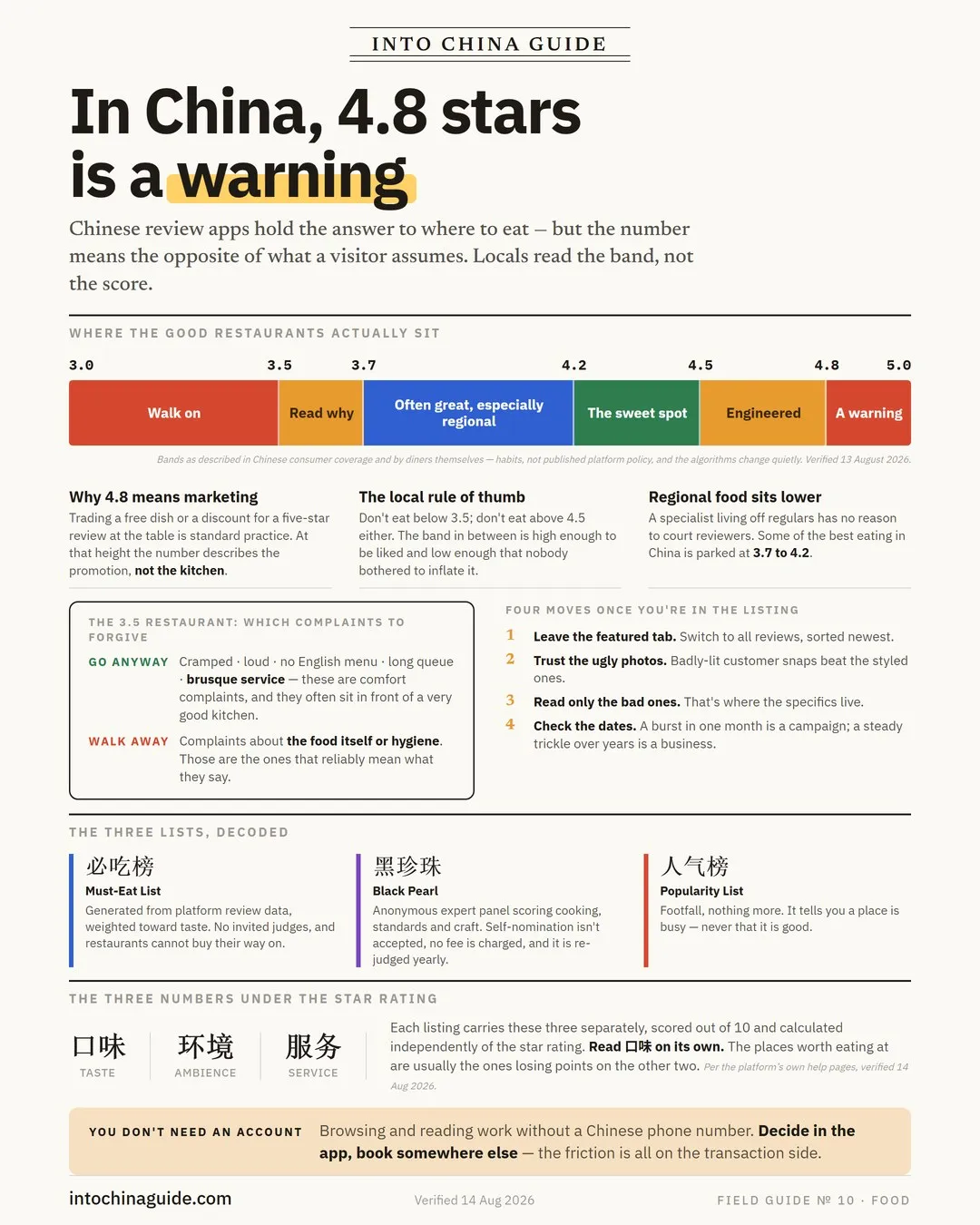
Chinese diners have absorbed this. The rule of thumb you'll hear is blunt: don't eat below 3.5, and don't eat above 4.5. Both ends of the scale are suspect, for opposite reasons. Here's how the bands read in practice:
| Rating | What it usually means | Why |
|---|---|---|
| 4.8 – 5.0 | Treat as a warning | At this height the reviews are usually bought — with free dishes, discounts, or a server asking for five stars at the table. |
| 4.5 – 4.7 | Popular, often engineered | Genuinely good places live here too, but so do the heavily marketed ones. Read the reviews rather than the number. |
| 4.2 – 4.5 | The sweet spot | Where locals expect to find a restaurant that is simply good. High enough to be liked, low enough that nobody bothered to inflate it. |
| 3.7 – 4.2 | Worth a look, especially for regional food | A specialist place living off regulars has little reason to court reviewers. Some of the best eating in China sits in this band. |
| Below 3.5 | Usually a real signal | At this point the complaints tend to be true. The exception is a tiny old shop with a handful of reviews — read them and judge. |
The 3.5-star restaurant, explained
A pattern Chinese media has covered for a couple of years now: diners deliberately seeking out restaurants rated around 3.5, on the theory that a low score often means the place never played the game. There is real logic underneath it.
The rating averages everything — decor, service, cleanliness, convenience — and a tiny shop with plastic stools, a shouting owner and one perfect bowl of noodles will be marked down on four dimensions out of five. Chinese coverage of the phenomenon has noted how hard it is for beloved hole-in-the-wall places to break four stars at all. Add the fact that a shop living off neighbourhood regulars has no reason to run a review campaign, and the low number starts to look less like a warning and more like a filter that keeps tourists out.
Reading the reviews the way locals do
The rating is a starting filter. The decision happens in the review section — and there is a specific way to read it that takes under a minute:
Leave the curated tab
The reviews you land on are the ones the restaurant wants you to see. Switch from 精选评价 (featured) to 全部评论 (all reviews) and sort to the newest. That single tap changes what you're reading from marketing to feedback.
Prefer the badly-shot photos
A page full of magazine-grade food photography is a page where someone was paid, or fed, to shoot it. The reviews with slightly crooked, badly-lit phone snaps are the ones written by people who just ate there.
Read the complaints, not the praise
Positive reviews in China are heavily incentivised and read the same everywhere. The one- and two-star reviews are where the real information is — and crucially, whether the complaints are about things you care about. 'Too spicy for me' and 'slow on a Saturday' are not the same warning as 'the fish was off'.
Check the review dates, not just the count
Thousands of reviews clustered around one month usually means a campaign. A steady trickle over years — even a modest one — is the pattern of a restaurant that simply keeps serving people.
The badges, and what each one is worth
Three different marks show up on restaurant pages and they mean completely different things. Only one of them is really built for taste:
必吃榜
Bì chī bǎng · Must-Eat List
Generated from the platform's own review data with taste weighted first — no invited judges, and restaurants can't pay their way on. The closest thing to a crowd verdict at scale, and the most useful badge for a visitor.
黑珍珠
Hēi zhēnzhū · Black Pearl
China's answer to a starred guide: anonymous expert judges scoring cooking, restaurant standards, and heritage or innovation, with conflicts of interest declared, no self-nomination, no fees from restaurants, and annual re-rating. Fine dining, priced accordingly.
人气榜 / 热门榜
Rénqì bǎng · Popularity charts
Traffic, not quality. Useful for knowing what's busy near you; useless for knowing whether it's good.
Doing this as a visitor
You do not need an account, a Chinese phone number or any Mandarin to use the method — reading is enough. Open the restaurant page, screenshot-translate the review text, and apply the same three questions a local applies: is the score in the honest band, do the photos look real, and are the complaints about comfort or about the food?
Where visitors do run into a wall is the transactional half — taking a table, claiming a deal, paying in the app. The workable split is to decide in the app and book somewhere else: the hotel front desk will call for you, many places take walk-ins with a queue number, and our own restaurant booking guide covers both — including the option of having us make the call.
One habit worth stealing outright: locals check the map before the menu. A restaurant that is excellent and forty minutes away loses to a very good one ten minutes away, on a day when you also want to see something. Our interactive map and trip planner exist largely because that arithmetic decides more meals than any rating.
Frequently asked questions
- What is a good Dianping rating in China?
- Lower than most visitors assume. Chinese diners commonly treat 4.2 to 4.6 as the band where genuinely good restaurants live, and read anything at 4.7 or above with suspicion, because ratings that high are usually inflated by free dishes or discounts offered in exchange for five-star reviews. A widely repeated rule of thumb is to skip anything below 3.5 and anything above 4.5 — for regional specialists, the floor drops further, and 3.7 can be an excellent meal.
- Why do some famous hole-in-the-wall restaurants have low ratings?
- Because the rating measures the whole experience, not the food. A small shop with plastic stools, no air conditioning, brusque service and one brilliant dish gets marked down on everything except the dish. It also has no marketing budget and no interest in review campaigns. Chinese media has covered the resulting phenomenon of diners deliberately seeking out 3.5-star restaurants — the number is a filter for tourists, not a verdict on the cooking.
- How can I tell if Dianping reviews are fake?
- Three tells. First, a page where nearly every photo looks professionally shot — real diners take crooked phone pictures. Second, a large cluster of reviews within a short window rather than a steady trickle over years. Third, uniformly glowing text in the featured tab; switch to all reviews, sort by newest, and see whether the tone changes. Restaurants openly offer discounts or free dishes for good reviews, so treat the top of the page as advertising.
- What's the difference between the Must-Eat List and Black Pearl?
- The Must-Eat List (必吃榜) is generated from the platform's review data with taste weighted first, without invited judges — a crowd verdict. Black Pearl (黑珍珠) is an expert guide with anonymous judges scoring cooking, restaurant standards and heritage, re-rated annually, with no self-nomination and no payment from restaurants — the fine-dining end. For an ordinary trip the Must-Eat List is the more useful badge; Black Pearl is for a special dinner.
- Can I use Dianping without a Chinese phone number?
- You can browse and read without an account, which is all this method needs — ratings, review text and photos are visible, and your phone's screen translation handles the Chinese. Where visitors hit friction is the transactional side: booking a table, claiming a group deal or paying in-app. The practical approach is to use the app to decide and something else to book — the hotel desk, a walk-in, or asking us.
Verified 2026-08-13. Rating conventions here are drawn from Chinese consumer coverage and how Chinese diners describe their own habits — they're norms, not published platform policy, and the platform adjusts its algorithms without announcement.Tell us if a rule of thumb here stops matching what you find.