Guide · Verified 2026-08-14
Booking Hotels in China as a Foreigner
Here's the thing nobody warns you about: not every Chinese hotel can check you in. It's not hostility — every guest in China gets registered with the police, and some small hotels have simply never processed a foreign passport through that system. The rules changed in your favor in 2024, but the practical fix hasn't changed: book somewhere that already welcomes foreign guests, and the whole issue disappears before you land.
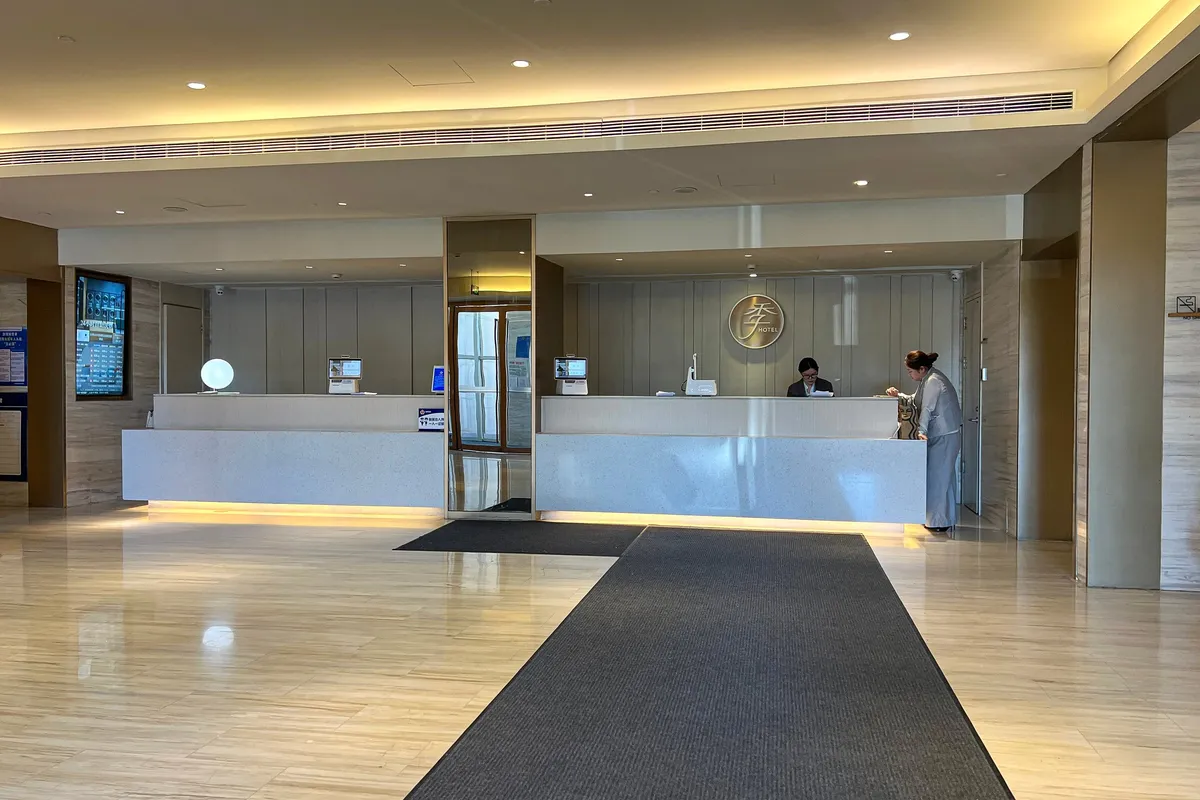
Why a hotel would refuse you (it's not personal)
Chinese law requires accommodation providers to register every guest's identity with the local public security bureau. For Chinese citizens that's an ID-card swipe; for foreigners it's a passport scan through a system some small-town desks have never touched. Historically, many budget hotels concluded it was easier to say "no foreigners" than to learn — which is how travelers ended up standing in lobbies at 10pm being waved toward the international chain across town.
Two things changed in 2024. In May, the Ministry of Public Security, the Ministry of Commerce and the National Immigration Administration answered the question that had been circulating for years: a hotel may not refuse an overseas guest on the grounds that it lacks "foreigner qualification" (涉外资质) — a designation that had been wound down over the previous two decades anyway, unevenly enough that plenty of desks still believe they need it. Then on 1 July, seven departments issued a joint notice on accommodation for overseas visitors, which says local authorities and booking platforms must not use qualification requirements as a threshold limiting hotels from hosting overseas guests, and that hotels and platforms shouldn't be publishing "no overseas guests" notices at all.
So the rules are clearly on your side. Here's the honest part about why it still happens anyway, which no English guide seems to explain:the hotel's risk is asymmetric. Refusing you has, in practice, carried little consequence — the 2024 notice asks provincial authorities to investigate and correct the problem, but explicitly frames enforcement as education-first rather than punitive. Getting your registration wrong, on the other hand, is a defined offence: under the Exit and Entry Administration Law, a hotel that fails to report a foreign guest's registration to the police gets a warning, and in serious cases a fine of ¥1,000 to ¥5,000. A small hotel that has never processed a foreign passport is doing the arithmetic and concluding that the safe answer is no.
Understanding that changes how you handle it. The clerk isn't refusing a person; they're avoiding a system they don't know how to use. That's why the fix below is about making it easy for them to say yes, and why the smart play is still to make acceptance a booking criterion rather than a check-in surprise.
If you're at the desk and they've said no
This is the scenario people actually fear — 10pm, a booked room, and a clerk shaking their head. Work through it in this order. The goal is to get a room tonight, not to win an argument, so stay friendly throughout: the person in front of you is worried about a system, not about you.
- Change the question. "Do you accept foreigners?" is a yes/no invitation to say no. Ask instead whether they can process accommodation registration for an overseas guest. Sometimes the honest answer is that they can, and nobody had asked it that way.
- If they cite "no foreigner qualification," say the sentence below. That qualification has been wound down over the past two decades, and in May 2024 the Ministry of Public Security, the Ministry of Commerce and the National Immigration Administration answered the question directly: hotels may not refuse overseas guests on the grounds of lacking it. Say it once, politely, and leave it there.
- Ask them to call the local police station. This is the step that resolves things most often, and it's the one travellers never think of. The desk's real fear is the registration system, and the neighbourhood station is the counterpart that can walk them through it — or take your details directly. You are not reporting the hotel; you're asking for the help they need.
- If you booked online, get the platform involved. The 2024 measures name booking platforms as well as hotels, and a prepaid booking gives customer service a reason to phone the property. Trip.com's English line is useful here precisely because it can call the hotel in Chinese while you stand there.
- Have the fallback ready before you need it. Know one international-chain hotel nearby that can always take you. Knowing it exists is what lets you handle steps 1–4 calmly.
| Show them this | Why it works |
|---|---|
| 你们能给境外人员办理住宿登记吗?Nǐmen néng gěi jìngwài rényuán bànlǐ zhùsù dēngjì ma?Can you process accommodation registration for an overseas guest? | The question that gets a useful answer. "Do you take foreigners?" invites a reflexive no; this asks about the actual capability. |
| 公安部、商务部和国家移民管理局已经明确:不得以没有涉外资质为由拒绝接待境外人员。Gōng'ānbù, Shāngwùbù hé Guójiā Yímín Guǎnlǐjú yǐjīng míngquè: bùdé yǐ méiyǒu shèwài zīzhì wéi yóu jùjué jiēdài jìngwài rényuán.The Ministry of Public Security, Ministry of Commerce and National Immigration Administration have stated that lacking "foreigner qualification" is not a valid reason to refuse an overseas guest. | Use it once, politely, and only if they cite the qualification. It is a fact, not a threat. |
| 可以麻烦您打电话问一下辖区派出所吗?Kěyǐ máfan nín dǎ diànhuà wèn yíxià xiáqū pàichūsuǒ ma?Could you please call your local police station and ask? | The move that actually works. The desk's fear is the registration system, and the local station is the counterpart that can talk them through it. |
| 我已经付款了,请帮我联系平台客服。Wǒ yǐjīng fùkuǎn le, qǐng bāng wǒ liánxì píngtái kèfú.I've already paid — please help me contact the booking platform's customer service. | If you booked online, the platform has leverage the desk cares about, and the 2024 notice names platforms too. |
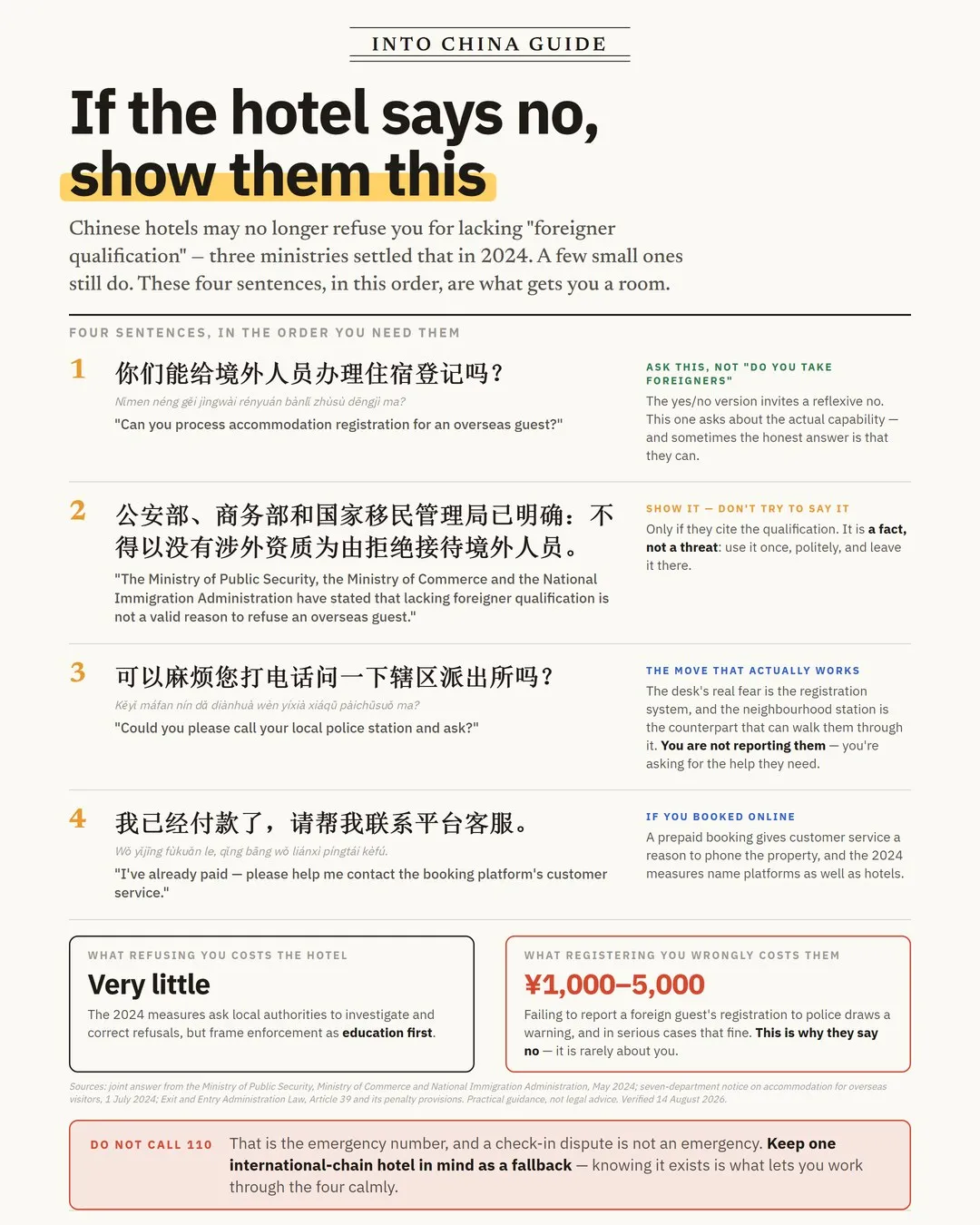
One thing not to do: don't call 110. That's the emergency number, and a check-in dispute isn't an emergency — it will not help you and it won't endear you to anyone. Cities run a 12345 government service hotline for non-emergency issues like this, though English support on it is patchy and it's a next-day remedy rather than a tonight one. Tonight's remedy is steps 1 through 5.
Which hotels take foreign guests?
| Hotel type | Foreigners? | Notes |
|---|---|---|
| International chains (Marriott, Hilton, IHG…) | Always | Foreigner registration is routine; English at the desk in big cities |
| Chinese mid-range chains (Atour, Ji Hotel, Orange…) | Almost always | Comfortable, modern, and used to foreign passports in tourist cities |
| Budget chains (Home Inn, 7 Days, Hanting…) | Mixed | Many branches are fine, some aren't set up for it — confirm before booking |
| Independent guesthouses & boutique inns | Check first | Lovely in old towns like Pingyao or Dali, but verify 'foreign guests accepted' |
| Hostels (YHA China and similar) | Usually | Backpacker hostels in tourist cities handle foreign passports daily |
| Private homes, Airbnb-style stays | You register | Legal, but YOU must register at the local police station within 24 hours |

How to book so this never becomes your problem
Book through Trip.com (the international arm of China's biggest travel platform) and the inventory you see is already filtered toward hotels that handle foreign guests — look for the "foreign guests accepted" note on the listing when you're eyeing a smaller property. The English-language customer service can also confirm directly with a hotel before you commit, which matters most for old-town guesthouses in places like Pingyao, Dali, or Lijiang, where the most charming courtyard inns are also the least corporate.
Two more habits worth adopting: avoid walk-ins at small hotels in non-touristy towns (that's where refusals still happen), and keep one international-chain backup in mind for late arrivals — they can always take you.
If you're booking a small independent place, one message before you pay settles it. Send it in Chinese — most desks read it faster than English, and the reply tells you what you need to know:
Nín hǎo, wǒ shì wàiguórén, chí hùzhào. Qǐngwèn guì diàn kěyǐ wèi jìngwài rényuán bànlǐ zhùsù dēngjì ma?
Hello — I'm a foreign national travelling on a passport. Can your hotel process accommodation registration for overseas guests?
A clear yes is a booking. A vague answer is a different hotel. Note that you're asking about capability, not permission — that's the question a front desk can actually answer.
What check-in actually looks like
Hand over your physical passport — a photo won't do, because the desk scans the real document into the police registration system. That scan is your registration; nothing further is required from you. This isn't hotel policy but Article 39 of the Exit and Entry Administration Law, which puts the duty on the hotel to register you and report it — the same article that puts the duty on you when you stay anywhere that isn't a hotel. Expect a refundable deposit (commonly ¥100–500 per night) on card, Alipay, or cash, returned at checkout. Rooms come as 大床房 (one big bed) or 双床房 (twin beds) — worth checking, since "double" is ambiguous in translation. Kettles are universal; free bottled water usually sits beside them.
Frequently asked questions
- Can all hotels in China accept foreigners?
- In principle yes. In May 2024 the Ministry of Public Security, the Ministry of Commerce and the National Immigration Administration stated that hotels may not refuse overseas guests for lacking "foreigner qualification", and a seven-department notice on 1 July 2024 told local authorities and booking platforms not to use qualification requirements as a barrier. In practice some small hotels still refuse, because staff have never processed a foreign passport through the police registration system. Booking somewhere that explicitly accepts foreign guests avoids the standoff entirely.
- What do I do if a Chinese hotel refuses to check me in?
- Five steps, in order. Ask whether they can process accommodation registration for an overseas guest rather than asking if they take foreigners. If they cite lacking foreigner qualification, mention politely that three ministries stated in 2024 that this isn't a valid reason. Ask them to phone their local police station — this resolves it most often, because the desk's real problem is the registration system and the station can walk them through it. If you booked online, have the platform's customer service call the hotel. And keep an international-chain fallback in mind so you can do all of this calmly. Don't call 110; a check-in dispute isn't an emergency.
- Why do some Chinese hotels still refuse foreigners if it's not allowed?
- Because the risk is lopsided. Refusing you has in practice carried little consequence — the 2024 notice frames enforcement as education-first. Getting your registration wrong is a defined offence: under the Exit and Entry Administration Law a hotel that fails to report a foreign guest's registration to police gets a warning, and in serious cases a fine of ¥1,000–5,000. A small hotel that has never done it once concludes that no is the safe answer. It's rarely about you personally, which is also why a calm approach works better than an argument.
- Do I need to register with the police when staying at a hotel in China?
- Yes, but the hotel does it for you — the front desk scans your passport at check-in and files your details with the local public security bureau automatically. That's the entire reason check-in requires your physical passport. You don't need to do anything else.
- What if I stay with friends or in a private apartment?
- Then the registration duty falls on you and your host: within 24 hours of arrival (72 in rural areas), register at the local police station with your passport and your host's ID and address documents. Some cities, including Beijing, let you do it online. Skipping it risks a warning or a fine of up to ¥2,000, and can cause friction with future visa applications.
- How much is a hotel deposit in China?
- Most hotels take a refundable deposit at check-in — commonly ¥100–500 per night on top of the room rate, paid by card, Alipay, or cash. It's returned at checkout after the room is checked. Budget for it so the hold on your card doesn't surprise you.
- Can I check in with a photo of my passport?
- No — the physical passport is required, because the desk scans it into the police registration system. A photo or photocopy won't be accepted, and neither will a driving licence. Carry the real document on any trip involving a hotel check-in or a train ride.
Verified 2026-08-14 against the seven-department notice of 1 July 2024 on accommodation for overseas visitors, the May 2024 joint answer from the Ministry of Public Security, Ministry of Commerce and National Immigration Administration, and Article 39 and the penalty provisions of the Exit and Entry Administration Law. This is practical guidance, not legal advice, and local enforcement varies — when in doubt, the "foreign guests accepted" label and a pre-arrival message to the hotel settle it. Tell us if a listed-as-friendly hotel turns you away. Photos: N509FZ; Hermann Luyken (room); CC BY-SA 4.0 / CC0, via Wikimedia Commons.