Guide · Verified 2026-08-15
DiDi & Taxis in China
You don't need to speak Chinese or negotiate a fare to get around — you need the right app open before you walk outside. Here's how DiDi actually works for a visitor, when a regular taxi is still the better call, and the one airport trick worth knowing before you land.
Four things called DiDi. Only three of them work here.
The first trap is upstream of everything else: the app your home app store offers you under the name DiDi is probably the wrong one. DiDi Rider — the international version — serves markets like Australia, New Zealand, Japan, Mexico and Brazil. It is a real app from the same company, and it does not hail cars in mainland China. People install it before flying, land, and find an empty map.
| Route | What it takes | How you pay | Verdict |
|---|---|---|---|
| DiDi inside Alipay | Open Alipay, search DiDi, ride. No second registration. | Alipay only — the mini-program is locked to its host app's wallet | Your default. Nothing new to set up if Alipay already works. |
| DiDi inside WeChat | Same idea, different host. | WeChat Pay only, same lock-in | Fine if WeChat Pay is the wallet you actually got working. |
| The standalone DiDi app | Download, register with your own foreign number, link a card. | Alipay, WeChat Pay or an international card — the only route with a choice | Worth it for a long trip: full app, in-app translated chat, English support. |
| “DiDi” from your home app store | Almost certainly DiDi Rider, the overseas app. | — | Does not serve mainland China. Wrong app, wrong country. |
The tradeoff between the two working shapes is payment, not features. A mini-program can only spend from the wallet it lives in — DiDi inside Alipay pays with Alipay, full stop. The standalone app is the only route that will take an international card directly, and it's also where the translated driver chat and round-the-clock English support live. For a week's trip the mini-program is fine. For a month, install the real app.

The four ways a ride actually falls apart
Booking a car is the easy part. Almost every visitor story that ends in standing on a pavement with luggage comes from one of these four, and all four are avoidable.
- The driver rings your foreign number and gets nowhere. The most common way a booking dies. Drivers routinely phone to confirm where you're standing, and an overseas number often won't connect — so they cancel and you start again. Use the in-app chat, which translates both ways, and answer it fast. If you'll be in China a while, a local eSIM number removes this failure entirely.
- The pin lands on the wrong side of the building. Airport terminals and major stations are big enough that GPS can drop you a five-minute walk from where the car can legally stop. Set the pickup point by hand from the app's list of named zones rather than trusting the automatic pin.
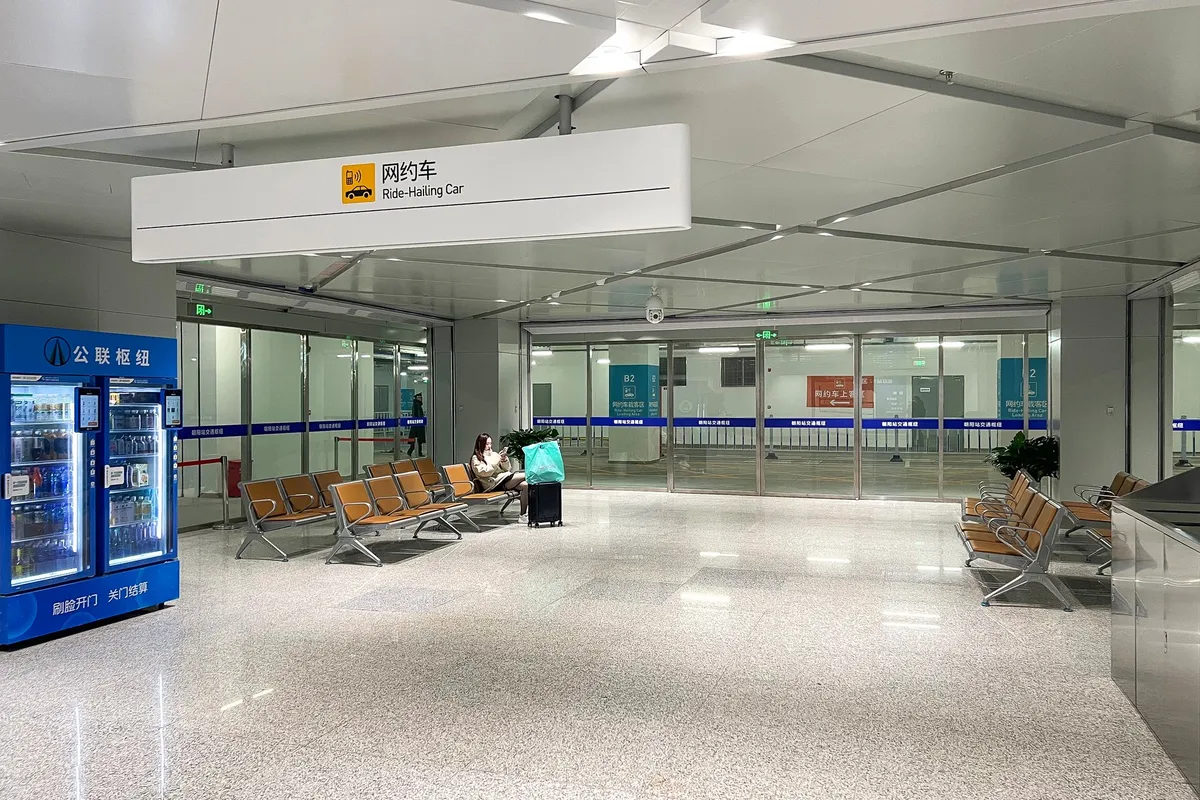
- You go outside and there is no curb to stand on. Ride-hailing cars can't stop at the arrivals kerb at most big Chinese airports. Pickup happens in a designated bay inside a car park, often a floor or two down, and the app carries photo directions to it. Budget about ten minutes from ordering to sitting down.
- The destination you typed isn't the one they know. English names of hotels and malls often don't resolve. Paste the Chinese address from your booking confirmation instead — it's the single highest-yield habit on this page.
The easiest way in: DiDi through Alipay
DiDi is China's dominant ride-hailing app — English interface, a fixed price shown before you accept, and the driver's plate number displayed so you can confirm the car before you get in. Rather than downloading DiDi separately, open it as a mini-program from inside Alipay: it uses the identity and linked card you already set up, so there's no second registration to fight with over a foreign phone number.
The standalone app is no longer the harder path it used to be — it takes an overseas phone number at signup and an international card for payment. The reason to start with the mini-program is simply that there is nothing to set up: if Alipay already works, DiDi already works.
Booking a ride, step by step
Set your pickup point (DiDi usually finds you via GPS, but confirm it — airport terminals and train stations are large enough that the pin can land on the wrong side of the building) and paste in your destination, ideally in Chinese characters copied from your hotel booking or our city guides. Confirm the fare shown before you tap request; that's the price you'll pay regardless of traffic or route.
When a driver accepts, the app shows their name, plate number, and car model — match all three before getting in, not just the color of the car. At busy pickup zones (airports, train stations, malls), DiDi will often point you to a specific designated ride-hailing area rather than the nearest curb, since drivers aren't allowed to stop just anywhere.
When a regular taxi is the better call
Taxis still make sense for short hops in a city center, late at night when ride-hailing demand-surge pricing kicks in, or in smaller cities where DiDi has thinner driver coverage. Look for an official taxi rank rather than flagging a random car, and insist on the meter ('dǎ biǎo') if a driver tries to quote a flat fare instead — especially outside airports and train stations, where the "broken meter, flat rate" routine is the most common tourist-facing scam in the country.
Most city taxis now accept Alipay or WeChat Pay, so cash isn't the necessity it once was — keep some on hand as backup, particularly in smaller cities, but don't plan a trip around needing it for taxis specifically.
Airport and station pickups without the hassle
Ignore anyone who approaches you inside the arrivals hall offering a ride — legitimate pickup zones, whether taxi or ride-hailing, are outside the terminal, and drivers working the crowd inside are exactly the ones to avoid. Follow the signage (usually bilingual, as pictured above) to the marked ride-hailing or taxi zone; airport staff can point you the right way if the signage isn't obvious.
For arrivals at a major hub, budget extra walking time to reach the pickup zone — it's common for these to be a level up or down from where you exit customs, not right outside the doors. Our airport arrival guide covers the immigration side of landing; this is what happens once you're through and looking for a ride.
Frequently asked questions
- Can foreigners use DiDi in China?
- Yes, and there are three working routes: DiDi as a mini-program inside Alipay, the same inside WeChat, or the standalone DiDi app. The mini-programs need nothing new if your wallet already works, but they lock payment to the host app. The standalone app accepts an overseas phone number and an international card, and adds translated driver chat and English support — better for a longer trip. One warning: the app called DiDi in most foreign app stores is DiDi Rider, which serves overseas markets and not mainland China.
- Why do DiDi drivers keep cancelling on me?
- Usually because they phoned to confirm where you're standing and couldn't reach you. Drivers commonly call rather than message, and an overseas number often won't connect, so after a minute or two they cancel. Watch the in-app chat instead — it translates in both directions — and reply immediately. A local eSIM number removes the problem outright.
- Where do I meet a DiDi at a Chinese airport?
- Not at the arrivals kerb. Ride-hailing cars are directed to a marked pickup bay inside a car park, often one or two levels down from arrivals, and the app carries photo-by-photo directions to the right one. Allow roughly ten minutes between ordering and getting in the car, and don't order until you've cleared baggage.
- Is DiDi cheaper than a taxi?
- It's usually comparable, sometimes slightly more for the convenience — the real advantage isn't price, it's that the fare is fixed and shown before you accept the ride, so there's no meter dispute and no language barrier over the destination.
- Do I need cash for taxis in China?
- Less than you'd think. Most city taxis now accept Alipay or WeChat Pay, and drivers increasingly prefer it. Keep some cash as a backup for older cabs or smaller cities, but don't count on needing much.
- Should I tip a DiDi or taxi driver?
- No. Tipping isn't expected for rides in mainland China, and offering cash can confuse a driver more than please them.
- How do I avoid taxi scams at the airport?
- Ignore anyone who approaches you inside the terminal offering a ride — legitimate taxis and ride-hailing pickups are outside, at marked zones. Use DiDi so the price is fixed in advance, or insist on the meter ('dǎ biǎo') with a marked taxi from the official rank.
Verified 2026-08-15. App registration flows and payment options change periodically — re-check the current sign-up steps if something on screen doesn't match. Tell us if a step no longer works.