Guide · Verified 2026-08-15
Why Alipay isn't working — and the fix for each
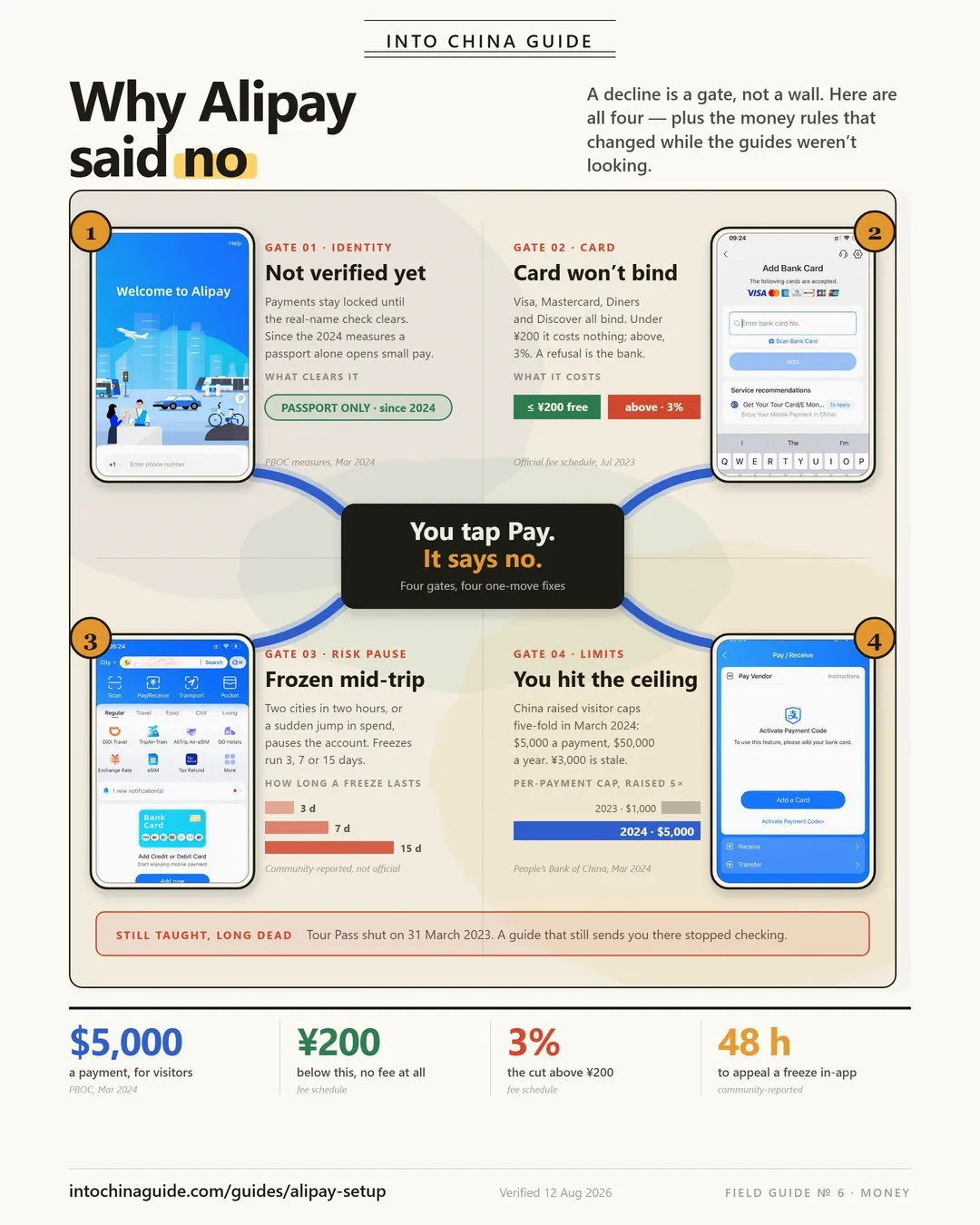
Almost every guide to Alipay describes the version where everything works. The version travellers actually meet is a card that won't bind, a payment that dies at a noodle counter, or an account frozen on day three of a two-week trip. A decline is a gate, not a wall — there are four of them, and each has a specific fix.
Gate 1 — the account isn't verified yet
Alipay keeps payments locked until its real-name check clears, and a freshly registered account often looks finished while the check is still pending. The tell is a payment code that generates but gets refused, or a card that binds and then can't be used.
Since the central bank's March 2024 package of measures, identity verification for visitors is deliberately lighter than it used to be: passport details alone are enough to unlock ordinary tourist-sized payments, with the fuller check reserved for larger sums. So this gate is usually a matter of finishing the form and waiting rather than hunting for a workaround.
The fix: open the app's verification section, enter the passport exactly as printed — including any middle names and both surnames if you have them — and let it settle before you're standing at a till. Do it on the plane or at the hotel, not at the front of a queue.
Gate 2 — the card won't bind
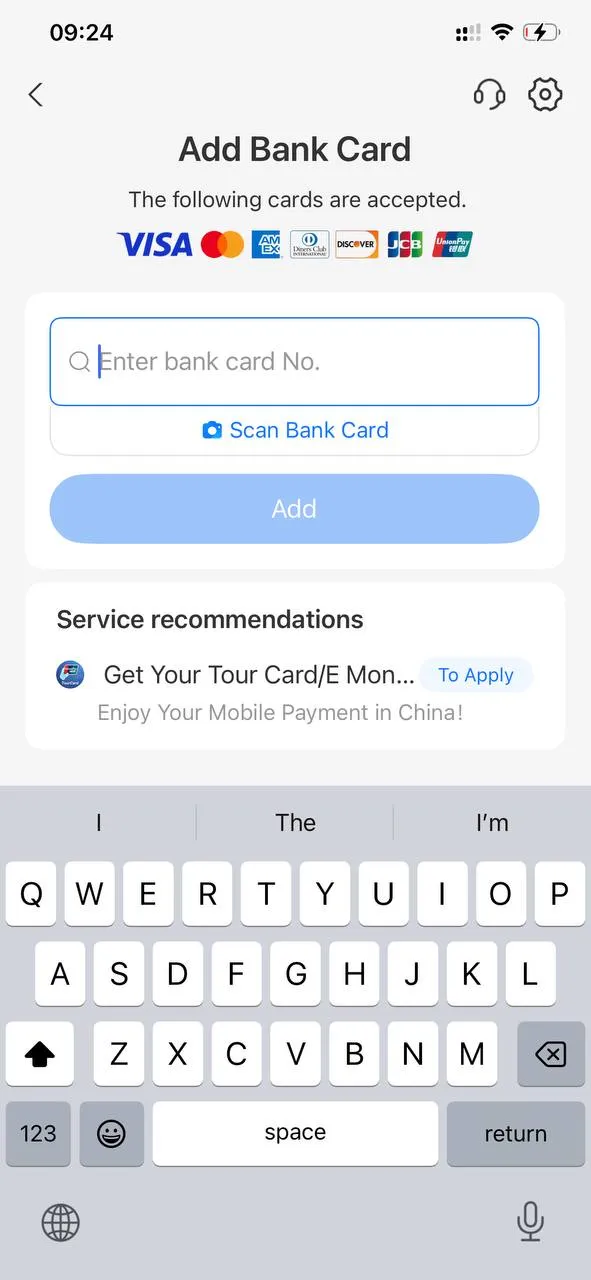
Alipay accepts Visa, Mastercard, JCB, Diners Club and Discover, and has added American Express. If yours is on that list and still won't bind, the refusal is usually coming from your own bank rather than from China: a foreign platform asking to store a card triggers exactly the kind of block your fraud team is paid to apply.
What it costs, once bound: a payment of ¥200 or less carries no service fee; above ¥200 the platform takes 3%. Worth knowing before you decide whether to put a ¥900 dinner on the app or pay another way.
The fix: tell your bank you're travelling in China before you leave, then try a different card if the first refuses — travellers report that a card from one issuer binds where another from the same network won't. Don't retry the same failing card repeatedly; a run of failed attempts is itself a risk signal.
Gate 3 — risk control paused the account
This is the one that frightens people, because it arrives without warning and usually mid-trip. The triggers travellers describe are mostly patterns that look automated rather than human: two cities in two hours, a sudden jump from small payments to a large one, a burst of retries after a failure, or receiving money from someone the system already distrusts. A tourist itinerary can produce the first two honestly, which is why this happens to people who did nothing wrong.
How long it lasts depends on which kind of hold it is — and that distinction is the useful part, because it tells you whether to wait or to act:
| What kind of hold | What clears it | Typical length |
|---|---|---|
| A routine risk check | Clears as soon as you pass the in-app verification | Minutes to hours |
| Identity details don't match | Re-submit the passport details, then wait | 1–3 days |
| Suspected rule-breaking | Formal appeal, documents reviewed | 7–15 days |
| A judicial hold | Nothing the app can do; handled by the authorities | Open-ended |
Durations above are what users report in Chinese-language forums and consumer coverage, not published policy. Treat them as a shape.
The fix: the freeze notice lands in the app's message centre, and the self-service appeal sits inside that notice rather than in the settings menu — which is why people miss it. The reported window for filing it yourself is 48 hours, with a response usually inside another 24 to 48. Upload what it asks for the first time; a half-finished appeal restarts the clock.
Gate 4 — you hit a ceiling
Limits for foreign visitors were raised sharply in March 2024, when China's central bank directed the major platforms to lift the per-transaction cap from US$1,000 to US$5,000 and the annual ceiling from US$10,000 to US$50,000. For an ordinary trip, that is no longer the binding constraint it was — the limit you're likely to meet first is your own card's.
Older guidance is the problem here. Guides written against the 2023 rules quote far lower per-payment ceilings, and they circulate widely enough that visitors talk themselves out of paying for a hotel by app. If a payment fails well below the current cap, read the message the app gives you rather than assuming the ceiling.
The fix: for a genuinely large payment — a multi-night hotel bill, a private tour — settle at the desk with a physical card instead of forcing it through the app, and keep the app for the day-to-day payments it's genuinely better at.
The metro gate — a different code entirely
This one isn't a fault in your account, which is exactly why it wastes so much time at a barrier with a queue behind you. The payment code and the transit code are two different things in two different places. The QR you hold up at a shop will not open a metro gate, no matter how many times you try it.
The transit code lives in its own section of the app. Set it up once, before you're standing at a gate: open it, agree to the transit terms, and it becomes a saved shortcut. It works for metro, buses and trams, and Alipay reports it running across roughly 45 city metro systems, with foreign-passport users supported in the major inbound-tourism cities — Beijing, Shanghai, Guangzhou, Shenzhen, Hangzhou, Nanjing, Chengdu, Suzhou, Kunming, Wuhan and Qingdao among them.

When it still doesn't open
- You're holding up the wrong code. Check you're in the transit section, not the pay section. This is the overwhelming majority of failures.
- Your location is wrong or off. Because the code adapts by city, a phone with location denied — or still convinced it's in the last city — can present the wrong one. Turn location on before you reach the gate.
- The screen is too dim. Gate scanners are unforgiving. Brightness up, and hold the phone flat against the reader rather than waving it.
- You have no signal underground. Open the code before you go down the stairs; some stations have poor coverage at the concourse.
Travelling with a child? Chinese transit systems price children by height rather than age, and thresholds vary between cities. A child cannot travel on your code — buy their ticket at the counter or a machine, and expect staff to eyeball the height mark at the gate. It is the one situation where the queue at the ticket window is unavoidable.
The advice that quietly expired
Two pieces of old guidance still circulate widely, and both waste your time:
"Get a Tour Pass." It stopped existing in March 2023, replaced by TourCard — a prepaid card usable in both Alipay and WeChat, with a higher top-up ceiling and longer validity than the old product. Most visitors now skip prepaid entirely and bind an international card.
"You need a Chinese bank account." You haven't for years. Binding an international card directly is the mainstream route, and the volume of foreign cards bound this way has grown steadily since the 2024 measures.
A rule of thumb that has served travellers well: if a payment guide still mentions Tour Pass, stop reading it. The rules in this area changed twice since it was written.
Frequently asked questions
- Why is Alipay declining my foreign card in China?
- Four things account for almost every decline: the account's real-name check hasn't cleared, the card itself refuses to bind (a bank decision, not an Alipay one), risk control has paused the account, or the payment is over a limit. Work through them in that order — the first two are visible in the app, and the second two announce themselves with a message rather than a silent failure.
- What are the Alipay payment limits for foreign visitors in 2026?
- China's central bank directed the major payment platforms to raise foreign-visitor limits in March 2024: from US$1,000 to US$5,000 per transaction, and from US$10,000 to US$50,000 a year. Older guides still quote much lower per-payment ceilings from the 2023 rules — if a payment fails well under the current cap, check the limit shown in your own app rather than trusting a blog figure.
- Does Alipay charge a fee on a foreign card?
- Yes, above a threshold. Payments of ¥200 or less carry no service fee; above ¥200 the platform takes 3%. The practical consequence is that splitting a large bill into small payments is not clever — the fee applies per payment over the threshold, and repeatedly splitting a payment is exactly the pattern risk control watches for.
- My Alipay account was frozen while travelling. How long does it last?
- It depends entirely on why. Travellers report that a routine risk check clears once you pass the in-app verification, mismatched identity details take a day or three to re-check, and a formal appeal over suspected rule-breaking runs one to two weeks. There is a self-service appeal in the app's message centre, and the reported window for using it is 48 hours from the freeze notice, with a response typically inside another 24–48 hours. These durations are what users report rather than published policy — treat them as a shape, not a promise.
- Should I get an Alipay Tour Pass?
- You can't — it stopped existing in March 2023, when it was replaced by TourCard, a prepaid card that works in both Alipay and WeChat with a higher top-up ceiling and a longer validity. Any guide still telling you to set up a Tour Pass has not been checked in three years, which is a reasonable reason to distrust the rest of it. Most visitors now skip prepaid cards entirely and bind an international card directly.
Verified 2026-08-15 against China's central bank announcements and the platforms' published fee terms; freeze and appeal timings are traveller-reported and labelled as such above. Payment rules here have changed more than once a year — tell us if something no longer matches what you saw.