Guide · Verified 2026-08-13
The China Packing List That's Actually About China
Most packing lists are the same list with the country name swapped. This one is organized around what actually goes wrong on China trips — the plug that doesn't fit, the power bank that gets confiscated at a domestic gate, the restroom with no paper. Pack for those and the rest is just clothes.
Documents: the boring 10 minutes that saves the trip
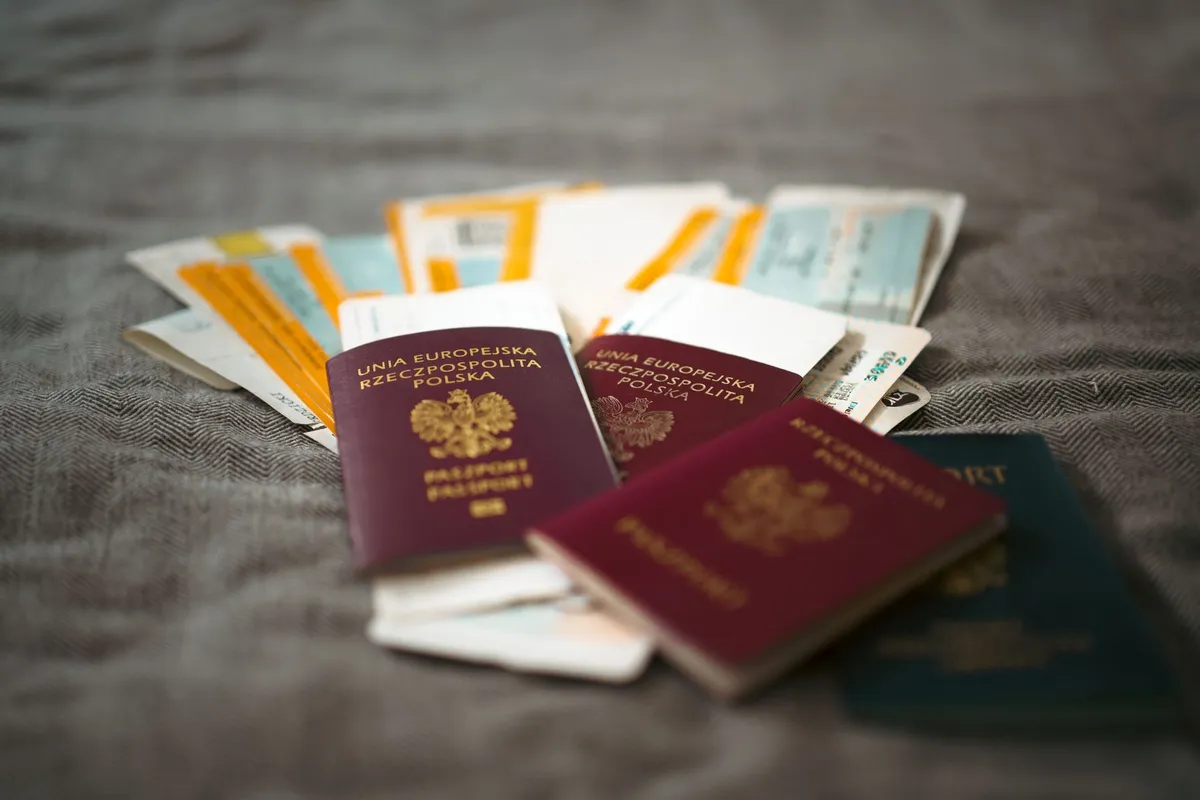
Passport, obviously — but also a paper photocopy kept separately from the original, plus photos of the ID page in your phone. China's trains, hotels, and many big attractions are real-name systems: the physical passport gets checked far more often than in Europe. If you're entering visa-free, check your eligibility on our visa-free checker and carry proof of your onward flight — border officers can and do ask. Print your first hotel's name and address in Chinese; it doubles as your taxi card.
Power: one adapter, one bank, one new rule
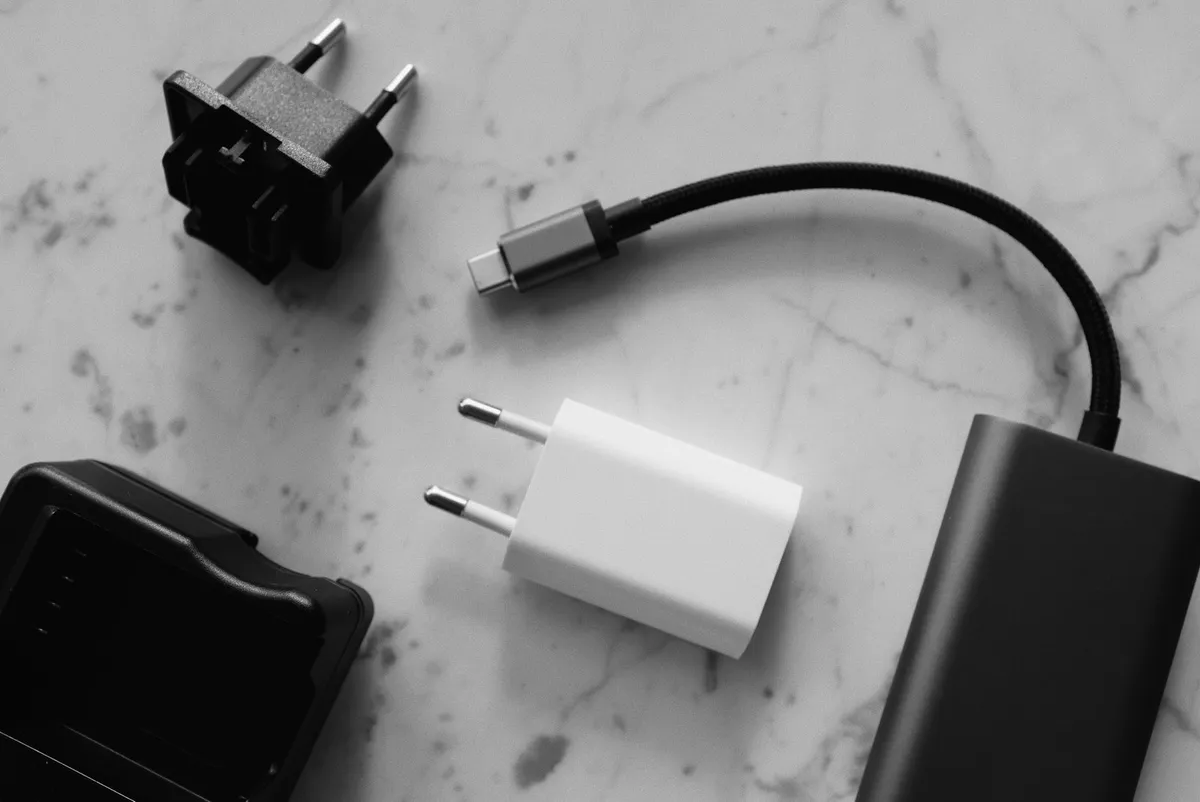
China runs 220V/50Hz on Type A and Type I sockets (hotels usually accept Type C too). Your chargers are dual-voltage, so skip the heavy converter — a plug adapter is enough, and hotel desks often lend them.
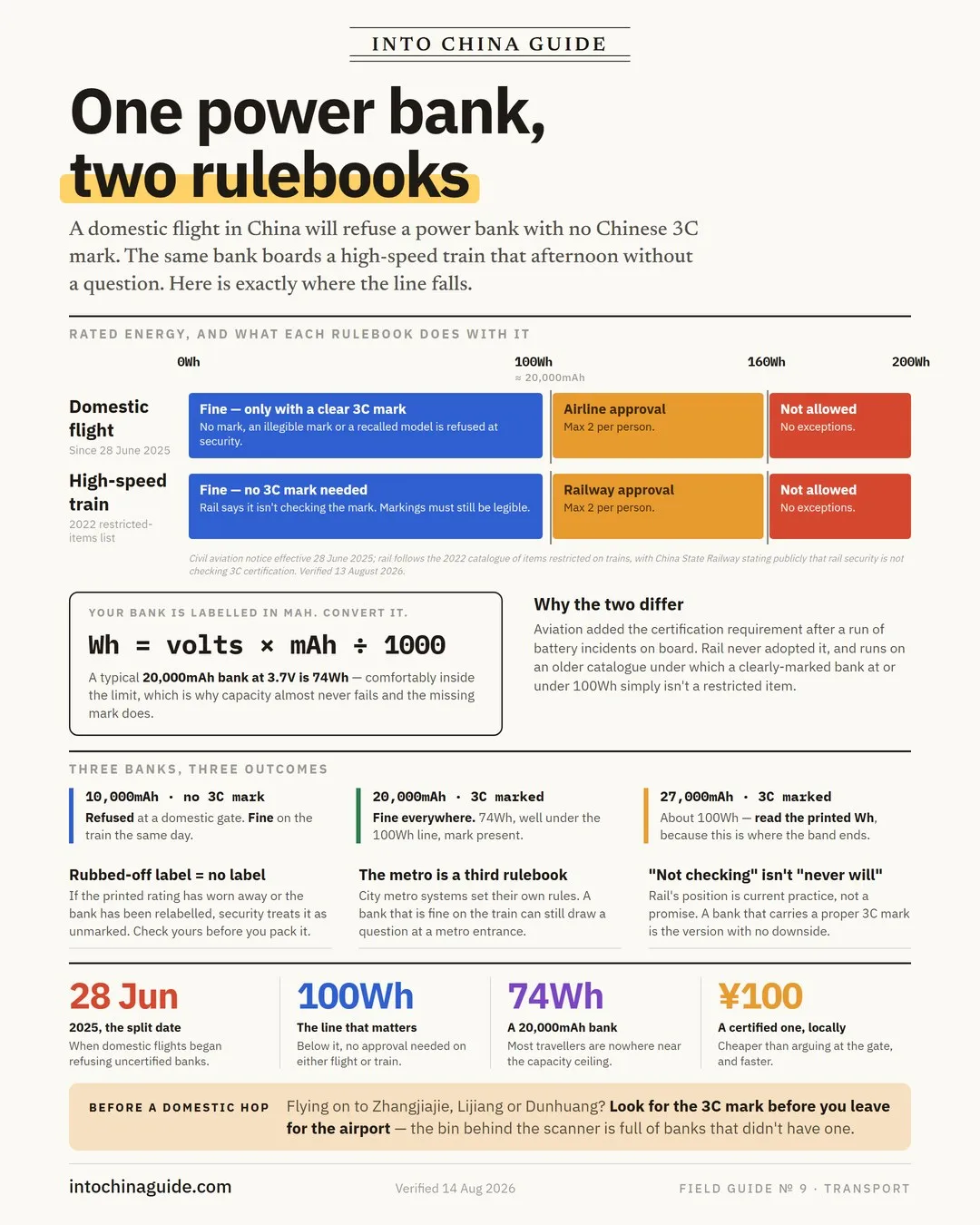
The power bank is the one item where China has its own rules, and where the rules differ between planes and trains — a split that catches out even travellers who did their homework.
On domestic flights, since 28 June 2025, the aviation regulator bans power banks that have no Chinese 3C certification mark, have a mark that isn't clearly legible, or belong to a recalled model or batch. Security at domestic gates checks, and the bin behind the scanner is full of confiscated banks. It applies to domestic flights inside China, not to your inbound international flight.
On trains, the same bank is fine. China State Railway has said publicly that rail security is not checking for the 3C mark; trains run on the 2022 catalogue of restricted items, under which a power bank with clear markings and a rated energy at or under 100Wh simply isn't a restricted item. So a bank that gets taken off you at an airport can travel with you on a high-speed train the same afternoon.
| Rated energy | Domestic flight | Train |
|---|---|---|
| Up to 100Wh | Fine — if it carries a clear 3C mark | Fine, no 3C needed, marking must be legible |
| 100–160Wh | Needs airline approval, max 2 per person | Needs railway approval, max 2 per person |
| Over 160Wh | Not allowed | Not allowed |
Two practical consequences. If your itinerary includes a domestic hop — into Zhangjiajie, Lijiang, Dunhuang — check your bank for the 3C mark before you fly, and if it isn't there, buy a certified one locally for around ¥100 rather than arguing at the gate. And be aware that city metro systems set their own rules, which vary between cities, so a bank that's fine on the train may still raise a question at a metro entrance.
One honest note: the rail position is "not currently checking", not "never will". If you're reading this well after the verification date above, a bank with a proper 3C mark is the version of this problem that has no downside.
The payment kit
Set up Alipay (primary) and WeChat Pay (backup) before you fly, bring two physical cards stored in different bags, and ¥300–500 in cash as the last-resort layer — small notes, not ¥100s that corner stalls can't change. Details on amounts in our cash guide.
Clothing: layers beat outfits
China's classic routes swing hard: Beijing can be 10°C colder than Guangzhou on the same day, train carriages are air-conditioned to "sweater", and sightseeing means hours outdoors. Pack layering pieces rather than looks — t-shirts, a warm mid-layer, one wind/rain shell — and shoes you've already walked serious distance in. For temples, anything covering shoulders and knees is respectful enough; nobody expects formal.
Health kit: bring your basics, buy the rest
Prescription meds in original packaging with a prescription copy; enough for the whole trip plus a few days. Add your preferred painkiller, stomach remedy, and motion-sickness tabs — all have local equivalents, but reading a Chinese pharmacy shelf jet-lagged is nobody's idea of fun. Strong opioid or psychotropic medication has stricter import rules: check with a Chinese embassy before flying.
The day bag (screenshot this)
| Item | Why it's in the bag |
|---|---|
| Passport | Trains, hotels, and many attractions check it — a photo isn't always accepted |
| Power bank | Your phone is wallet + tickets + translator; a dead battery is a genuine emergency |
| Pocket tissues | Public restrooms often don't stock paper — the single most veteran item on this list |
| Hand sanitizer | Same reason as the tissues |
| ¥100–200 in small notes | For the one stall that can't scan your QR code |
| Hotel card in Chinese | Show it to any taxi driver when your phone dies |
What to leave at home
- A voltage converter — phone and laptop chargers are dual-voltage; you only need a plug adapter
- A week of toiletries — Watsons and convenience stores are everywhere and cheap
- An umbrella — buy one for ¥20 when it rains, abandon it without guilt
- Formal wear — even nice restaurants in China are casual
- A money belt — this isn't a pickpocketing hotspot; a zipped inner pocket is plenty
Frequently asked questions
- What power adapter do I need for China?
- China uses 220V/50Hz with Type A (two flat pins, US-style) and Type I (three flat pins, Australian-style) sockets; hotels usually take Type C (two round pins) too. Phone and laptop chargers are dual-voltage, so a simple plug adapter is all you need — no converter.
- Can I bring a power bank to China?
- Yes, in carry-on only, with a rated energy up to 100Wh (about 20,000mAh at 3.7V). The catch is that planes and trains apply different rules. Since 28 June 2025, domestic flights inside China ban power banks with no Chinese 3C certification mark, an illegible mark, or a recalled model — and security does check. Trains do not: China State Railway has said rail security isn't checking for the 3C mark, and a clearly-labelled bank at or under 100Wh isn't a restricted item. If your trip includes a domestic flight, verify the mark before you go or buy a certified bank locally for around ¥100.
- Why can I take my power bank on a Chinese train but not a plane?
- Because they run on different rulebooks. Civil aviation added the 3C certification requirement for domestic flights in June 2025 after a series of battery incidents. Rail still applies the 2022 catalogue of items restricted on trains, under which a power bank with clear markings and a rated energy at or under 100Wh isn't restricted at all — and China State Railway has confirmed rail security isn't checking certification marks. Note this is a current position rather than a promise, and city metro systems set their own rules on top.
- Can I bring my medication to China?
- Personal quantities of everyday prescription and OTC medication in original packaging are fine; bring a copy of the prescription for anything beyond the basics. Strong painkillers and psychotropics have stricter rules — check with a Chinese embassy before flying if you rely on them.
- What shoes should I pack for China?
- Your most comfortable walking pair, already broken in. City sightseeing days in Beijing or Xi'an routinely hit 20,000 steps, and the Great Wall is effectively a stair workout. A second lighter pair is nice; heels are a mistake.
- What should I pack for Chinese train travel?
- Keep passport, valuables, and a day of essentials in a small bag at your seat — large cases go on racks by the door. Snacks and a refillable bottle help (every station and train has free hot-water dispensers — very Chinese, very useful for instant noodles).
Verified 2026-08-13. Airline and rail battery rules evolve — recheck before flying domestic. Tell us if a rule has changed.