Guide · Verified 2026-08-13
Riding China's High-Speed Rail
Booking the ticket is one problem — our booking guide covers 12306 vs. Trip.com, the 15-day sale window, and station-day timing. This one is about the part nobody explains in advance: what actually happens once you're standing on the platform with a suitcase, and then once you're in the seat.
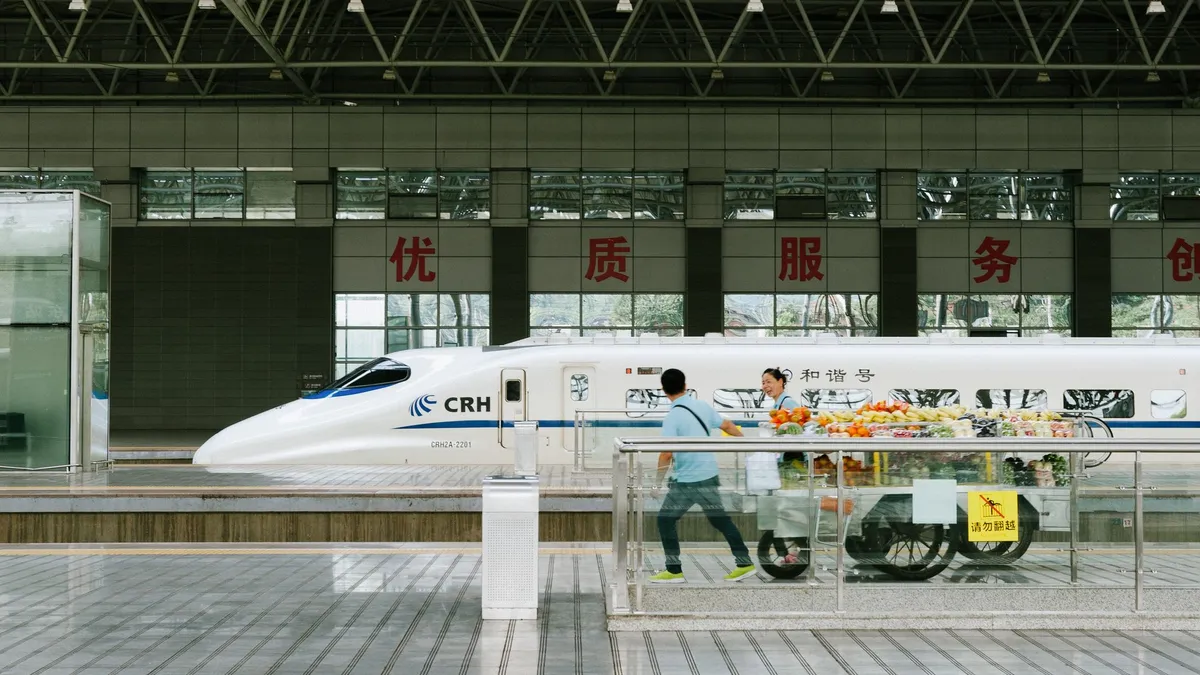
Finding your seat
Your electronic ticket shows a car number and seat number — there's no paper ticket, so keep the booking confirmation open on your phone or written down. Platform signage marks where each car will stop once the train pulls in, numbered along the platform, so you can walk to roughly the right spot before boarding instead of guessing once you're inside.
Inside, second class is typically laid out 3 seats on one side of the aisle and 2 on the other, forward-facing with a fold-down tray table built into the seatback in front of you — closer to economy air travel than a European train compartment. First class has 2-and-2 seating with more room; business class (on routes that offer it) is a lie-flat splurge. Overnight sleeper trains use a different car layout entirely — soft sleeper compartments sleep four, hard sleeper compartments sleep six, open to the corridor.
Where your luggage actually goes
The overhead rack is shallow — fine for a backpack or a small carry-on, not built for a 28-inch suitcase. Real luggage goes in the open racks at the end of each car, right by the connecting doors between carriages, or in the gap behind the very back row of seats in a car. Board as early as your platform position allows if you're travelling with big bags, because that space is first-come, first-served and fills up fast on a full train.
Keep valuables, chargers, and anything you need mid-journey with you at your seat rather than at the far end of the car — you won't want to walk the length of a moving train to reach a charger.
One rule that surprises people: your power bank is welcome here even if an airport took issue with it. Since June 2025, domestic flights in China refuse power banks without a clear Chinese 3C certification mark. Rail runs on a different rulebook — China State Railway has said rail security isn't checking for that mark, and a bank with legible markings and a rated energy at or under 100Wh isn't a restricted item at all. The full comparison, including how to convert mAh to Wh, is in our packing guide.
Food, water, and the trolley cart
A trolley cart works its way down the car selling instant noodles, snacks, boxed meals, and drinks — cash and mobile pay both work. Nearly every car has a hot-water tap near one end, which is what the instant-noodle cup is actually for; bring your own cup noodles if you have a preference. Longer routes (multi-hour, cross-region) may have an actual dining car partway down the train; shorter city-to-city hops generally don't bother with one because the trip is over before it matters.
Toilets, quiet, and onboard etiquette
Most cars have both a squat toilet and a Western sit-style toilet at one end, marked with a pictogram — if one is occupied or the queue is long, the other type is usually free. Some newer high-speed trains also run a designated quiet car; check the car diagram on your ticket or the signage by the door if you want one. Phone calls and video on speaker are common in ordinary cars, so pack earbuds if you're sensitive to noise.
Boarding and getting off without a scramble
Boarding gates typically open around 15 minutes before departure and close about 5 minutes before — see the booking guide for the full station-day checklist. Once you're moving, screens inside the car announce the next station in Chinese and English on major routes and show which side the platform will be on.
The part that catches people out: at a fast intermediate stop, the train may only sit for two to five minutes before moving again. If your stop isn't the final destination, start gathering your things and move toward the doors one station ahead — don't wait until the announcement for your own stop. This matters even more with big luggage stored at the end of the car, since retrieving it and reaching the door takes longer than you'd expect on a train that's only stopping briefly.
Frequently asked questions
- Is there assigned seating on Chinese high-speed trains?
- Yes — every ticket (except standing tickets on some routes) is tied to a specific car and seat number, shown on your electronic ticket. Find your car number on the platform signage before boarding, since cars are numbered in sequence along a very long train and walking the length of one isn't realistic once you're on board.
- Where does luggage go on a Chinese high-speed train?
- Overhead racks handle a standard carry-on, but a large suitcase won't fit up there. Use the open luggage space at the end of each car (near the connecting doors) or the gap behind the last row of seats. There's no dedicated hold like a plane, so board early enough to claim that space before it fills.
- Is there food on the train?
- A trolley cart passes through selling instant noodles, snacks, and drinks, and most cars have a hot-water tap for your own cup noodles — a genuine institution on Chinese trains. Longer routes may have a dining car partway down the train; shorter city-to-city hops usually don't need one.
- Are the toilets squat or Western-style on the train?
- Both — most cars have one of each at the end, usually marked with a pictogram on the door. If one's occupied, check the other end of the car rather than assuming there's only one type.
- What happens if I miss my stop or the doors close fast?
- At a fast intermediate stop, the train may only sit for 2–5 minutes, so get up and move toward the doors one stop ahead of yours, especially with luggage. Screens inside the car show the next station and which side (left or right) the platform is on. If you do miss a stop, tell a conductor immediately — there's a process, but it's an avoidable hassle.
Verified 2026-08-13. Exact car layout, dining-car availability, and quiet-car policy vary by train model and route — the specifics above describe the typical Fuxing/CRH high-speed experience, not every service. Tell us if a detail doesn't match what you rode.