Guide · Verified 2026-08-13
China's 24-hour bathhouses, explained
Ask a Chinese friend what to do on a cold evening with nothing planned and a decent chance they'll say 洗浴中心 — the bathhouse. It is one of the country's genuinely great everyday pleasures, it is almost invisible in English-language travel writing, and for the price of two coffees it will also let you sleep there. Here is the whole thing, including the parts nobody tells you until you're already undressed.
What it actually is
Forget the word "spa". A Chinese xǐyù zhōngxīn (洗浴中心) is a multi-floor leisure complex built around bathing. The lower floor is single-sex and wet: hot pools at several temperatures, a steam room, a dry sauna, rows of shower stations, and attendants who will scrub the top layer off you on a tiled table. Everyone down there is nude, and everyone is entirely uninterested in you.
Upstairs is the part visitors never expect. Everyone puts on the same house robe and the floor becomes mixed: restaurants, recliners with screens, films, sometimes karaoke and a games arcade, and quiet halls of sleeping chairs. Couples come on dates. Families bring children. Groups of friends arrive at ten at night and leave after breakfast. Entry is typically valid for a full 24 hours, and plenty of venues never close at all.
The visit, step by step
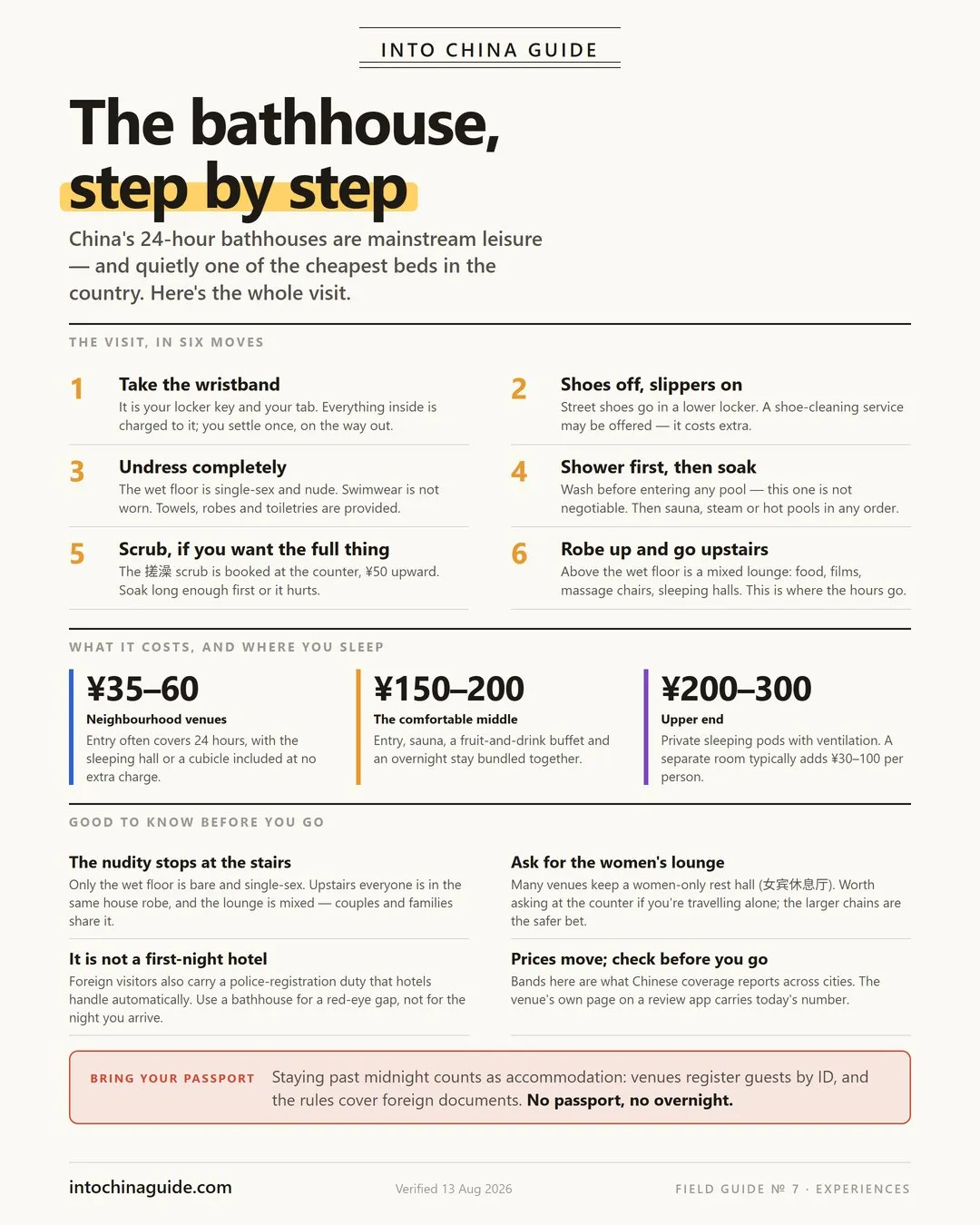
You're handed a wristband, not a bill
At the door you get an electronic wristband with a number on it. It is your locker key and your tab at the same time — every drink, scrub and bowl of noodles inside gets charged to it, and you settle once at the end. Nothing inside is paid for at the point of use, which is disorienting the first time and very pleasant afterwards.
Shoes off before anything else
Street shoes go into a low locker near the entrance and you change into house slippers. Staff may offer to clean your shoes while you're inside; that's a paid extra, and declining is completely normal.
The wet floor is nude and single-sex
Past the changing room you undress completely. Swimwear is not worn and would mark you out. Towels, robes, slippers, shampoo and body wash are all provided, so you can arrive with nothing. Everyone here is doing the same thing and nobody is looking.
Shower first, then get in the water
This is the one rule with no flexibility: rinse thoroughly at the shower stations before entering any pool. After that, move between hot pools, steam room and dry sauna in whatever order you like.
The scrub, if you want the full experience
The famous 搓澡 scrub is booked at the counter and done by an attendant on a tiled table. Soak for a good fifteen minutes first — it softens everything and makes the difference between invigorating and painful. Expect ¥50 upward depending on the venue and how elaborate you go.
Robe up and go upstairs
Above the bathing floor sits the part visitors don't expect: a mixed-sex lounge in matching house robes with restaurants, recliners, films, sometimes karaoke or a games arcade, and rows of quiet sleeping chairs. Families and couples spend whole afternoons here.
What it costs
Pricing splits cleanly into three bands. These are what Chinese consumer coverage reports across cities rather than a fixed tariff, so treat them as the shape of the market:
| Entry | What you get | Notes |
|---|---|---|
| ¥35–60 | Neighbourhood venues | Entry frequently covers a full 24 hours, with a sleeping hall or a cubicle included at no extra charge. Basic, clean, local. |
| ¥150–200 | The comfortable middle | Entry plus sauna, a fruit-and-drink buffet and an overnight stay bundled together. The band most visitors will enjoy most. |
| ¥200–300 | Upper end | Private sleeping pods with their own ventilation, better food, quieter floors. A separate room typically adds ¥30–100 per person on top. |
On top of entry: the scrub from around ¥50, food and drinks charged to the wristband, and a private sleeping room or pod at roughly ¥30–100 per person where the venue offers one. The wristband makes it easy to lose track — glance at the tally before you settle up, the same way you would with a bar tab.
Sleeping there — and the rule that catches foreigners
This is the part that turned bathhouses into a minor travel story: at many venues, a bed for the night is simply included in an entry fee under ¥100, and Chinese coverage in 2026 has noted foreign visitors discovering it. For a red-eye departure, an early train, or a night when the city is full, it genuinely works.
The rule to know: staying the night counts as accommodation. Venues that let guests sleep are managed under hotel-industry rules and register overnight guests by identity document — and those rules cover documents issued outside China, which means a passport is accepted and also required. Turning up without one and expecting to sleep is the single most likely way to be turned away at midnight.
Worth doing the comparison honestly before you count on it: at the ¥100-ish mark a bathhouse bed is competing with actual budget hotel rooms in most cities, and a hotel gives you a door that locks and a check-in desk that expects a passport. The bathhouse wins on availability at 2am and on the experience being part of the trip — not usually on price alone. Worth checking what a room costs that night before you decide (affiliate link — no extra cost to you).
Going alone, and going as a woman
Solo visitors are completely ordinary here — a great many customers arrive alone, bathe, eat and sleep without speaking to anyone. The language barrier is smaller than you'd think, because the whole sequence is physical: hand over the wristband, follow what everyone else is doing, point at the counter for a scrub.
For women travelling alone, two practical points. Many venues keep a women-only rest hall (女宾休息厅) upstairs — worth asking about at the counter if you intend to sleep rather than discovering it later. And choose size over price: the large, well-reviewed venues run tighter access control between the men's and women's floors, while the incidents that make the Chinese news tend to come from small operations with lax supervision. That's the same instinct you'd apply to picking a hostel.
Bring nothing but a passport and a phone. Everything else — towels, robe, slippers, toiletries — is on the shelf when you walk in.
Frequently asked questions
- What is a Chinese 24-hour bathhouse actually like?
- A large multi-floor leisure complex, not a spa in the Western sense. The lower floor is a single-sex bathing area — hot pools, steam and dry saunas, showers, and attendants who give exfoliating scrubs — where everyone is nude. Above it sits a mixed-sex lounge in house robes with restaurants, recliners, films and sleeping halls. Entry is usually valid for 24 hours, families go together, and many venues never close.
- Can I sleep at a Chinese bathhouse instead of a hotel?
- Physically yes, and cheaply — at many venues the sleeping hall is included in an entry fee of well under ¥100, and Chinese coverage in 2026 has noted foreign visitors discovering this. Legally it's treated as accommodation: venues register overnight guests by ID under hotel-industry rules, and those rules explicitly cover foreign documents, so bring your passport. One caveat English guides miss: foreign visitors in China also carry a police-registration obligation that hotels handle for you automatically. Use a bathhouse for a red-eye gap or a night between trains, not for the night you arrive in the country.
- Do I need to be naked at a Chinese bathhouse?
- On the bathing floor, yes — it's single-sex and swimwear isn't worn. That floor is the only nude part. Once you shower off and put on the house robe, everything upstairs is mixed and clothed, which is where most of the hours actually get spent.
- How much does a Chinese bathhouse cost?
- Chinese coverage across cities puts neighbourhood venues at roughly ¥35–60 for entry, often including an overnight stay in the sleeping hall; a comfortable mid-range venue at ¥150–200 with sauna, buffet and overnight included; and upper-end venues at ¥200–300 with private sleeping pods. A scrub is extra, from about ¥50. Prices move, so check the venue's own page on a review app for today's number.
- Is it safe for a woman to go to a Chinese bathhouse alone?
- The bathing floor is single-sex and attended, and solo women are ordinary customers rather than a curiosity. Two practical points: many venues run a women-only rest hall (女宾休息厅) upstairs, worth asking for at the counter if you plan to sleep; and larger, established venues have tighter access control between the men's and women's areas than small ones — incidents that make the Chinese news tend to involve the latter. As anywhere, pick the big well-reviewed place over the cheapest one.
Verified 2026-08-13. Prices and venue practices here are drawn from Chinese consumer coverage and vary by city and by venue; the identity-registration rules for overnight stays come from published hotel-industry regulations. Check the venue's own page on a Chinese review app for current pricing before you go, and tell us if something here no longer matches.